The debate about whether hybrid work would last is over. Across Europe, approximately 30% of workers now operate in a structured hybrid arrangement, with fully remote work stabilised at roughly 12–15% of the workforce, concentrated in technology, finance, and professional services. The two-to-three day office week has become the standard contract at most major European employers.
What has changed in 2026 is the formalisation. According to Eurofound’s research on European hybrid work strategies, hybrid arrangements are no longer informal team-level decisions, they are increasingly codified in policy, negotiated with worker representatives, and underpinned by digital infrastructure. In seven of the ten European organisations studied by Eurofound for their 2025 report, hybrid models actually predated the pandemic. The crisis accelerated adoption; it did not invent the concept.
- 67% of organisations globally are now operating some form of hybrid work (CBRE / HubStar, 2025)
- Over 60% of European companies report average office attendance of 41–80%, up more than 10 percentage points year-on-year (CBRE, 2025)
- 75% of leasing in European office markets is now concentrated in prime CBD locations (Cushman & Wakefield, 2026)
Attendance is recovering, but the pattern is uneven. Office usage consistently peaks on Tuesdays and Wednesdays, with Fridays remaining the quietest day of the week regardless of employer policy. That midweek clustering has direct implications for how buildings need to operate — demand is not flat across five days, it is spiky across two or three.
Technology and talent: the twin drivers
Eurofound’s research identifies five primary reasons why European organisations are deepening their commitment to hybrid models in 2026. Labour market competitiveness leads the list: in tech and knowledge sectors particularly, offering structured hybrid is now a talent differentiation strategy, not a perk. Digital transformation is the second driver, hybrid work both requires and accelerates investment in collaborative platforms, cloud tools, and workplace management software. Cost efficiency through reduced footprint follows closely behind.
The implications for real estate are significant. Companies are not simply shrinking their office footprints and walking away. They are trading down on square metres and up on quality, choosing locations that offer better amenities, transit connections, and digital infrastructure in exchange for less total space.
The flight to quality and the obsolescence risk below it
European office market data for 2025 and early 2026 tells a consistent story: the best buildings are winning, and the gap with everything else is widening.
According to Cushman & Wakefield’s European Outlook 2026, prime office rents across Europe rose 3.7% over the past year, while construction remains at a decade low. Vacancy rates in major markets including Madrid, Amsterdam, Berlin, and Warsaw are falling or have peaked. In its H1 2025 office market update, Cushman & Wakefield tracked 5 million square metres of leasing activity — up 1.7% year-on-year and slightly above the five-year average.
“As we head into 2026, there is still risk on both sides of the outlook, but we have moved past the peak levels of uncertainty. Capital is flowing again, interest rates are stable or moving lower, and leasing fundamentals are generally stabilising or improving.”
— Kevin Thorpe, Chief Economist, Cushman & Wakefield
But below the prime tier, the picture is considerably more difficult. Cushman & Wakefield’s dedicated report, Rethinking European Offices: Turning Obsolescence into Opportunity, estimates that more than 70% of office buildings in Western Europe are at risk of becoming functionally, financially, or legally obsolete by 2030. The EU Energy Performance of Buildings Directive will require all new buildings to be zero-emission from 2030, and public buildings must reach that standard by 2028. Buildings that cannot meet those thresholds will face a sharply narrowing tenant pool.
CBRE’s European Market Outlook reinforces this: tenants are more willing to compromise on the grade of office space than on its location, connectivity, and amenities. The question for landlords is no longer simply whether a building is full, it is whether the building is the kind of place people actually want to be.
What tenants are actually asking for
The research is consistent on this point. Modern tenants, particularly in technology, finance, and professional services, are evaluating office buildings on a set of criteria that go well beyond rent per square metre. They want spaces that justify the commute; that make it easy to book a desk, a meeting room, or a parking space before they leave home; that surface community events and services; and that their employer can report on for sustainability credentials.
Assigned seating has fallen to just 25% of companies surveyed by CBRE, down from 40% in 2024. By 2027, 73% of organisations expect a desk-to-employee ratio above 1.5:1. The practical consequence: buildings without digital booking infrastructure are increasingly unmanageable for the tenants that occupy them.
Digitalisation as a competitive asset for landlords
Here is the opportunity that the current moment creates. As tenants consolidate into fewer, higher-quality spaces and demand richer workplace experiences, the landlords and space operators who have invested in building digitalisation are finding themselves with a clear competitive advantage in both tenant acquisition and retention.
From passive asset to active platform
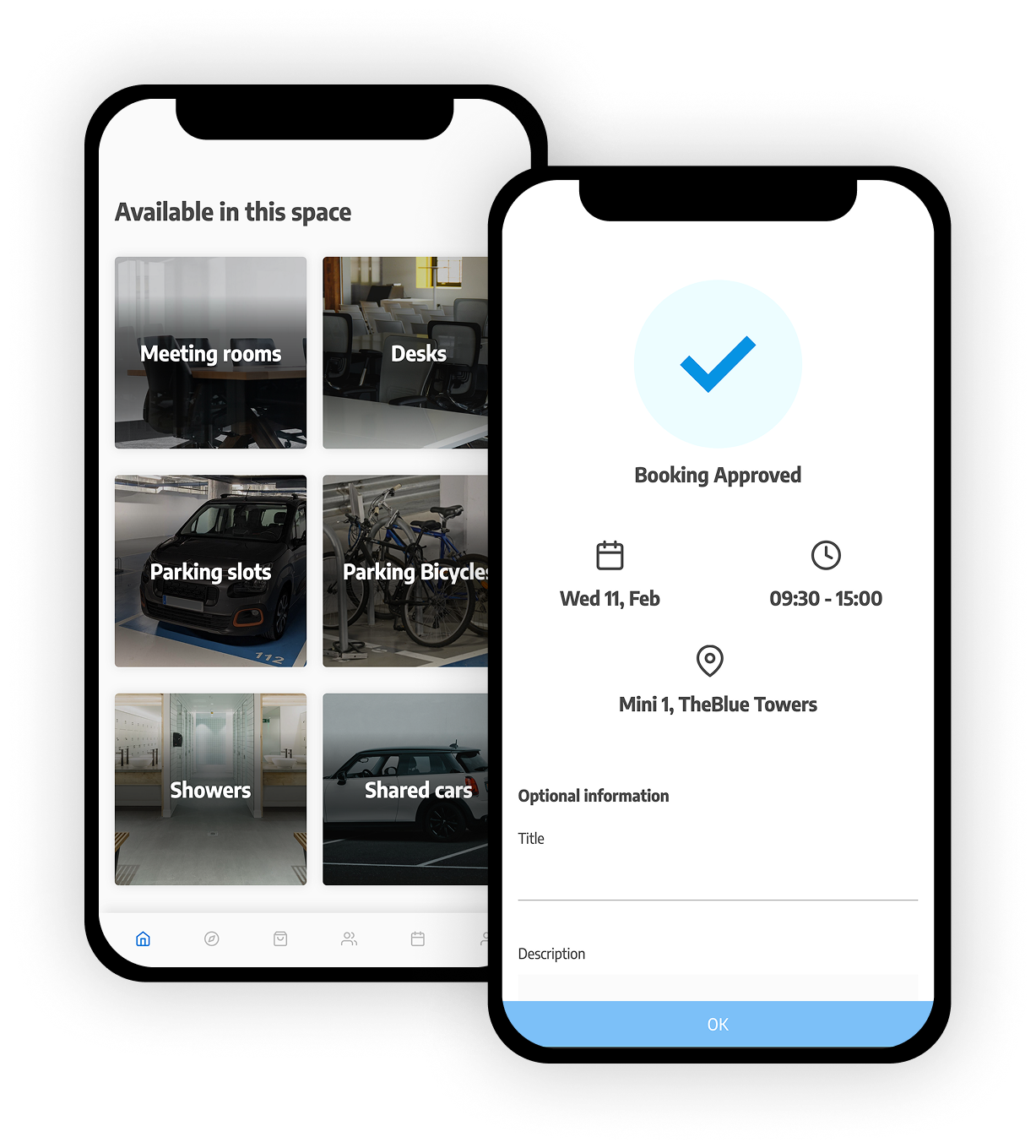
The traditional landlord relationship was simple: provide four walls and working utilities, collect rent. The new model is more like operating a platform. Tenants expect the building itself to surface and manage its own resources: desks, meeting rooms, parking, access, events, services, through software that works on a phone, integrates with their existing calendars, and gives their facilities teams real-time occupancy data.
This is not a niche requirement from early adopters. PwC’s Emerging Trends in Real Estate Europe 2026 found that digital connectivity and smart building technology are now among the top criteria institutional investors use to evaluate European office assets. Buildings that can demonstrate digital infrastructure are commanding longer leases, lower incentives, and rental premiums — often running into double digits above comparable undigitised stock.
What a connected building enables:
- Real-time occupancy monitoring lets tenants right-size their space usage — and lets landlords demonstrate utilisation data that supports lease conversations.
- Seamless desk and room booking reduces friction for hybrid workers and removes the coordination overhead that makes office attendance feel like effort rather than benefit.
- Community and event management tools turn a building into a place — enabling networking, shared programming, and the kind of spontaneous connection that neither fully remote nor fully in-person mandates can manufacture.
- Integration with access control, parking, and transport extends the building’s value proposition to the entire commute journey, not just the time spent at a desk.
The tenant acquisition argument
For space operators and landlords actively competing for tenants in 2026, digital infrastructure is increasingly a prerequisite for being considered, not a differentiator after the shortlist is made. Technology and professional services companies, the tenants that make up the largest share of European prime office demand, arrive at lease negotiations with clear expectations about what a building’s digital layer should look like.
Mordor Intelligence’s 2026 analysis of the European office market noted that IT and ITES sectors accounted for 31.6% of European office real estate take-up in 2024, growing at a 4.89% CAGR through 2030. These tenants have specific requirements: buildings must support hybrid scheduling, space analytics, and community features in a way that integrates with existing enterprise software stacks.
Buildings that can offer this, through a unified platform rather than a patchwork of disconnected tools, are shortening their leasing cycles and reducing vacancy periods. Buildings that cannot are finding themselves competing primarily on price, which is a diminishing-returns strategy as the supply of prime space remains constrained.
The sustainability dimension
Digitalisation and sustainability are increasingly inseparable in the European office market. Aberdeen Investments’ Q4 2025 European Real Estate Outlook flagged climate physical risk as the second most important ESG credential for accessing finance, cited by 83% of respondents. PwC’s Emerging Trends report noted that the European Environment Agency has identified Europe as the fastest-warming continent, making sustainability credentials a financial risk management issue, not a marketing exercise.
Smart building platforms generate the occupancy and energy data that landlords need to report against EU sustainability frameworks and to qualify for green certifications. Certified buildings already achieve longer leases and premium rents. As the 2030 Energy Performance of Buildings Directive deadline approaches, the gap between certified and non-certified stock will only widen.
What this means for 2026 and beyond
The European office market in 2026 rewards a specific combination: prime location, high-quality physical space, genuine digital infrastructure, and sustainability credentials. That combination is not especially rare at the top of the market, but it is still uncommon in the mid-tier stock that makes up the majority of European office inventory.
For landlords and space operators, the window to act before the 2030 regulatory threshold is narrowing. The buildings that invest now in digital and sustainability infrastructure are building a durable moat. Those that delay are likely to find themselves competing for a shrinking pool of tenants willing to accept undigitised, non-certified space, and facing increasingly adverse financing conditions as institutional capital continues to tilt toward ESG-compliant assets.
For companies choosing where to work, the message is equally clear: the office now has to earn its place in a hybrid week. That means the building itself — not just the neighbourhood or the brand of the landlord — needs to offer a frictionless, well-managed, community-rich experience. Software is no longer the tenant’s problem alone; it is part of the building’s value proposition.
Hybrid work did not kill the office. It raised the bar for what an office needs to be.
Solutions for office & facilities Teams
Manage the hybrid schedule and avoid overbooking or no-shows.

Solutions for owners & asset managers
Increase asset value, reduce operational costs, and leverage real usage data.
Sources & further reading
- Cushman & Wakefield — European Outlook 2026 (December 2025)
- Cushman & Wakefield — Rethinking European Offices: Turning Obsolescence into Opportunity (2024–2025)
- Cushman & Wakefield — European Office Market Update H1 2025 (September 2025)
- CBRE — European Real Estate Market Outlook 2025 — Office
- CBRE — European Real Estate Market Outlook Mid-Year Review 2025
- PwC / ULI — Emerging Trends in Real Estate Europe 2026
- Aberdeen Investments — European Real Estate Market Outlook Q4 2025
- Eurofound — Shaping the Future of Work: Inside Europe’s Hybrid Work Strategies (June 2025)
- Eurofound — The Hybrid Workplace: Ensuring Benefits for Workers and Organisations (November 2025)
- Mordor Intelligence — Europe Office Real Estate Market — Forecast & Outlook 2030 (2026)
Photo by Musemind UX Agency on Unsplash