This new reality will be challenging, with the need to solve many issues like social distancing, people density in offices, access & visit control, contactless management, communication and emotional support.
The office and open spaces as we know them might be gone, but useful solutions exist for the short, mid and long term challenges of the post covid-19 offices. And as always technology can help.
Short-term: solving the way back equation
A secure environment, where processes will help maintain social distance, prevent excess interactions between people while providing a productive and healthy spot for everyone. How do we fix this logistic headache?
Basically, this means new ways to manage space density and better control who is coming in, when and how.
What should be done:
– Limit people in spaces, to guarantee adequate social distancing
– Offer alternatives to home office, helping people manage better their work/life balance, and access proper work environments (who’s really willing to work from the couch more than a few hours?)
– Better communicate with teams, about health protocols, last news, etc.
– Avoid, or streamline external visits, to reduce interactions
– Offer emotional support to individuals and teams. Addressing stress caused by the context (workload, infrastructure and personal context) is key.
– Cleaning, cleaning, cleaning.

How to make it happen?
Not everything can be done in the short term. Changes involving infrastructures will need several months to be deployed. Meanwhile, quick wins can be achieved through:
– Appointing a Health Manager, a person in charge of coordinating the new initiatives taking place
– Increase cleaning activity in the space, to prevent any spread of the virus.
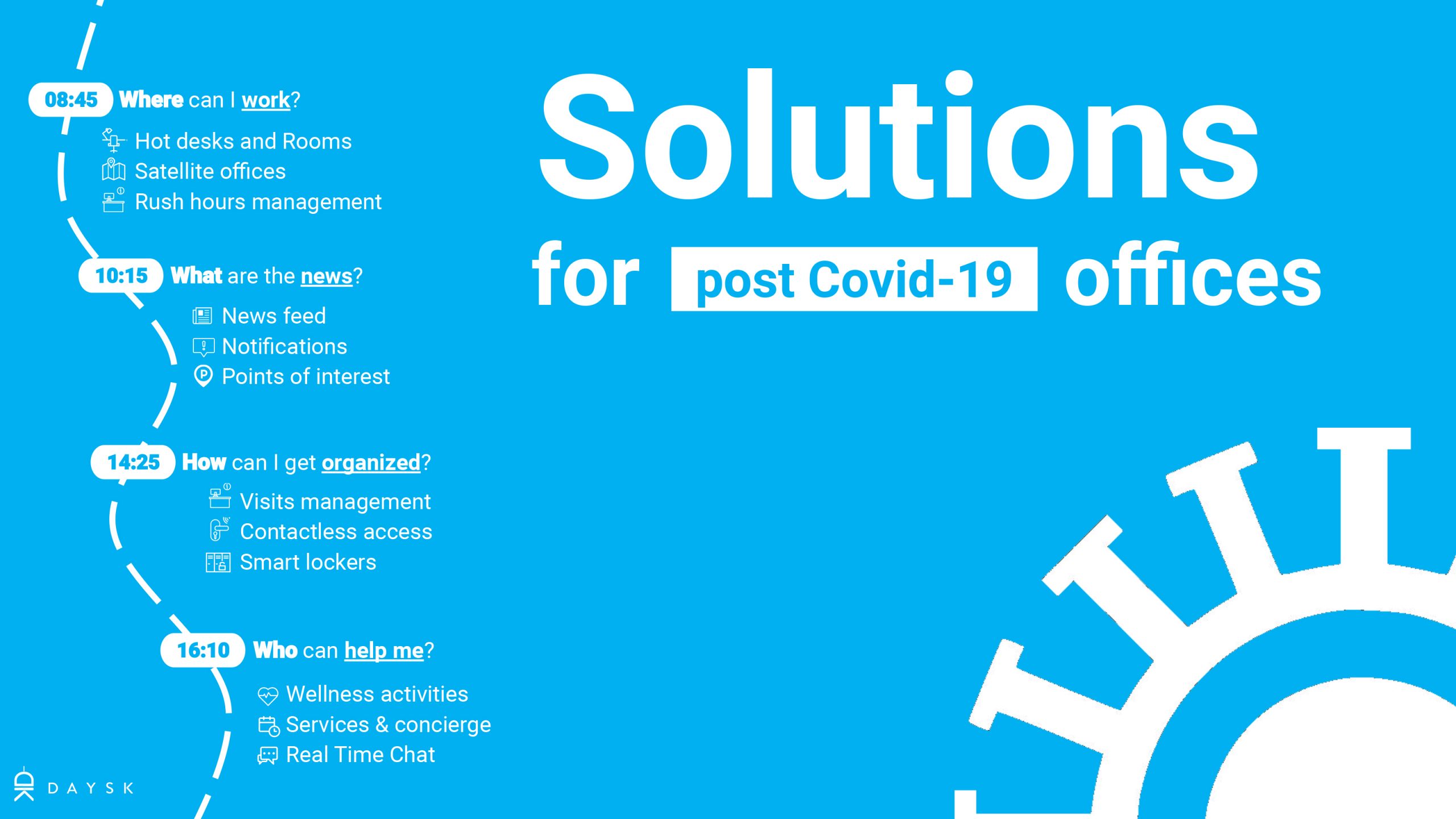
– A booking system to limit daily occupation in the office
– The same booking system can spread access to the building over time, to lower the “rush hour effect”
– The same flexible booking system would allow for rotation of employees between on site and remote working, easily managing offer of flex desks and demand.
– Access to coworkings near home, as alternative to “couchworking” and to prevent unnecessary commute.
– Offering online events, addressing key “hot” topics, from remote work trainings to managing emotional stress
– Implement technology to support your actions, when it does not require complex integrations: indoor mapping and digital signage to help getting the most of the space and services supporting healthy initiatives, for example.
Long-term: toward a new way to work
In the mid to long term, we bet flexibility and remote working will be permanent.
Most companies will reduced their rented square meters and accomodate with rotation of use and telework. Spaces can adapt and offer solutions that will ease these new habits while automating operations.
For companies and headquarters, it’s an opportunity to boost happiness at work and productivity, incurring less fixed cost for office rent while simplifying the management of all services, from parkings to catering.
Further technical integrations like smart doors for contactless access, connected lockers for automatic deliveries and other tech improvements will become the norm.
New furnitures and new air conditioning system will also be needed.
Several network of offices are moving toward these directions, lowering density, improving communication and personal flows within their installations.
The future is brighter that we can think yet, but it’ll get time and efforts to get there.
Luckily, Technology solutions like Daysk can help smoothen the way to the new normal.
About Daysk:
Daysk is transforming the way people work by making office buildings more connected.
We offer a turn-key software solution to help Real Estate investors, innovation hubs and corporates better manage their offices and service offering.
Our simple SaaS platform connects all tenant-facing technologies and amenities for office buildings, creating vivid communities, boosting space operations and fostering more business opportunities, while helping resolve the post covid-19 challenges listed above.
Interested?
– Download our brochure with our covid-19 solutions here (english upon request)
– Get in touch ! [email protected]